



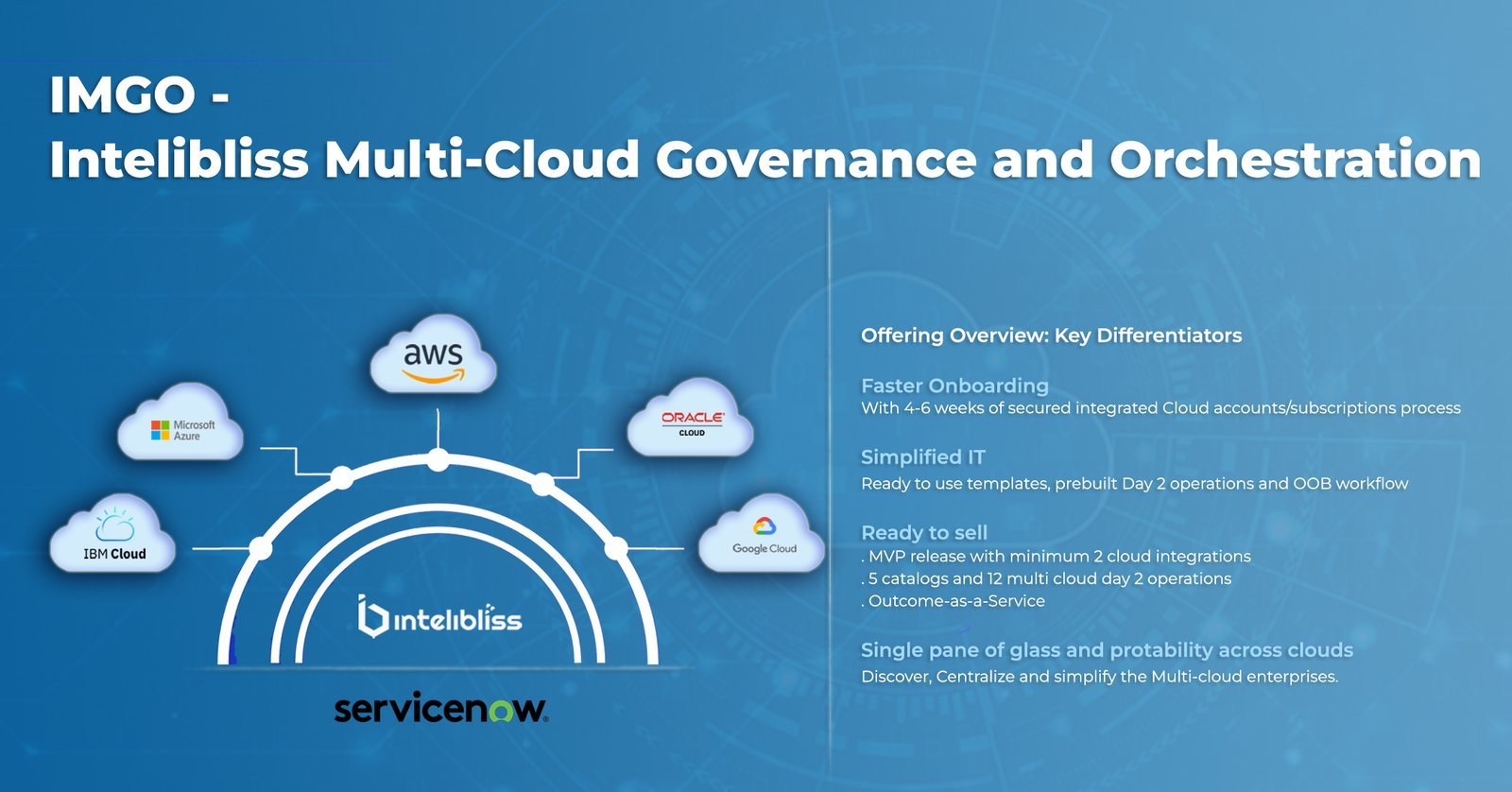
Update, October 2026: IMGO was built on ServiceNow Cloud Provisioning and Governance, which ServiceNow has since marked for deprecation. Its successor is OneCloud, a new application with no dependency on CPG or Cloud Services Catalog. The approach to moving is in our CPG deprecation article.
A European managed service provider came to us with a familiar problem. Their cloud services were growing, their customers expected quick provisioning and accurate billing, and the tooling behind the scenes hadn’t kept up. This is what they were dealing with, what we built with IMGO (the Intelibliss Multi-cloud Governance and Orchestrator, now sold as OneCloud), and what changed.
The starting point
Three issues were costing the MSP time and money.
Split provisioning. Services were provisioned through two different routes, which meant two sets of records, two ways of tracking what had been built, and regular inconsistencies between them.
Multiple cloud providers, managed separately. The public cloud estate ran across several providers. Each had its own console, its own admin model and its own view of what existed, so oversight was fragmented.
No central view. Resource management was decentralised. Nobody could see all customers, projects and resources in one place, and reporting meant pulling data from several systems by hand.
The MSP wanted one platform that could handle provisioning, give every stakeholder the view they needed, and keep cost and documentation under control.
What we built
IMGO runs on ServiceNow ITOM, so the MSP got the platform’s workflow, approval and CMDB capabilities as part of the solution rather than as extra integration work. The specific components were:
A dedicated portal with role based access. Project managers, administrators and cloud specialists each saw the information and actions appropriate to their role, from the same portal.
A single interface for account and project information. Users could view and update account and project details in one place instead of across the providers’ consoles.
An integrated knowledge base. Articles on provisioning each service type were available from inside the portal, which shortened the learning curve for new services and new staff.
A central repository for invoices and reports. Past invoices and generated reports were stored and organised in one place, which made audits and historical analysis straightforward.
Separate workspaces per project. Projects with different needs could manage their own services within their own workspace, without affecting anyone else.
What changed
Cloud resource access became a price book. Administrators could offer cloud resources from a defined price list, so customers and project teams could see what was available and what it cost before requesting it.
Cost calculation was automated. An integrated cost calculator worked out charges from the price book, which removed a manual, error-prone step and made billing transparent.
Pricing updates propagated immediately. When a service or its price changed, the price book updated and every quote and report reflected it straight away.
Beyond the mechanics, users across roles reported routine tasks taking less time, which freed the team for work that mattered more. The knowledge base turned out to be as useful for experienced engineers as for new joiners. And the document repository reduced the effort of record keeping and compliance, because auditors and administrators could find historical data without asking around.
Technology
- ServiceNow ITOM, for visibility and operational workflow.
- ServiceNow Cloud Management (Cloud Provisioning and Governance), for provisioning and lifecycle management of cloud resources.
- Cloud Insights, for cost and utilisation data that fed the optimisation recommendations.
How the rollout went
We planned the implementation in phases to avoid disrupting live customer operations, and ran training sessions for each user group as their part of the platform went live. Adoption was high, partly because the portal replaced several tools people were glad to stop using, and feedback from both technical and non-technical users was positive.
Takeaways
The MSP’s problems weren’t exotic: two provisioning paths, several consoles, no single inventory. What made the difference was treating cloud management as a ServiceNow workflow problem rather than a tooling problem for each provider. If you run a similar estate, the same three questions are worth asking: where do requests come in, where is the authoritative list of what exists, and where does the cost data live? If the answer to each is “it depends”, that’s the gap IMGO was built for.
