



The Common Service Data Model is the best thing to happen to ServiceNow data in a decade, and the most common source of stalled programmes. The model is not hard. Adopting it across an organisation that has been doing its own thing for years is. Here is how we take customers through it in slices.
Know which stage you are really at
Most customers who tell us they are at stage 2 have pockets of stage 3 and large areas of stage 0. The assessment comes first: which business applications exist, which technical services are modelled, how CIs relate to them, and which ServiceNow applications are already consuming the model. We score completeness, correctness and compliance per class, so the plan is based on data rather than opinion.
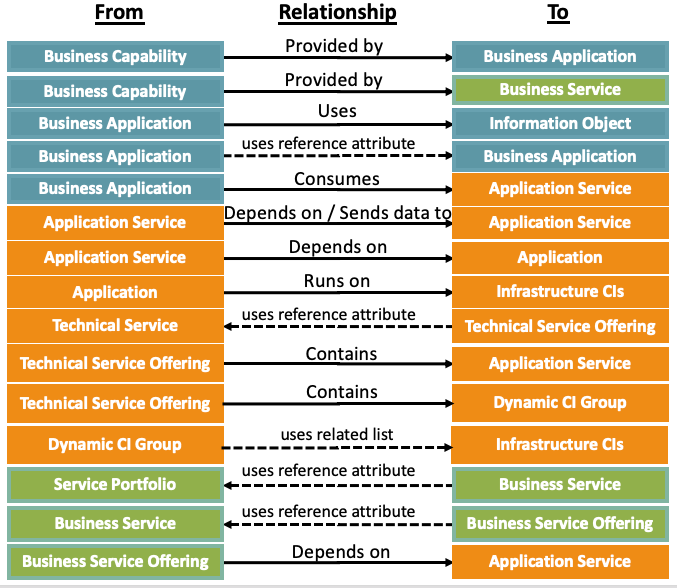
The compliance score is the one that catches people out. It is not enough for a record to exist; it has to be related to the right things in the right direction. These are the relationship rules we check for, class by class.
Crawl: foundation data and ownership
Business applications, application services and their owners. This is the slice that opens up everything else, because ITSM, SPM and SecOps all key off it. Ownership is the hard part and it is a people conversation, not a configuration one. We run it as a short series of workshops with the application portfolio team and leave a maintained register behind.
Walk: technical services and service offerings
Connect the applications to the infrastructure that runs them, through Service Mapping where the services are critical and through Discovery relationships elsewhere. Define service offerings for the services the business actually consumes, with the SLAs that already exist in contracts. Stop modelling the moment a model has no consumer.
Run: the applications start to use it
This is where CSDM pays back. Incident impact calculated from the service map. Change risk assessed against the services a CI supports. Vulnerabilities prioritised by the business service they expose. Otto and AI Agents that can reason about services rather than servers. Each consumer you connect is a reason for the data to stay accurate.
Fly: keep it healthy without heroics
Data policies, CMDB health dashboards and a monthly review that takes an hour, not a day. We leave every customer with a health score they can track and a short list of the data rules that keep it high.
The point of CSDM is not the model. It is a platform whose decisions you can trust, including the AI ones. Our CMDB and CSDM page describes the two-week assessment we start with.
