



Most Event Management rollouts stop at correlation. Alerts become fewer and better, operators are happier, and then nothing changes for two years. The gap between correlation and automatic remediation is where the real savings sit, and it is crossed in four deliberate steps.
1. Make the CMDB the source of truth for impact
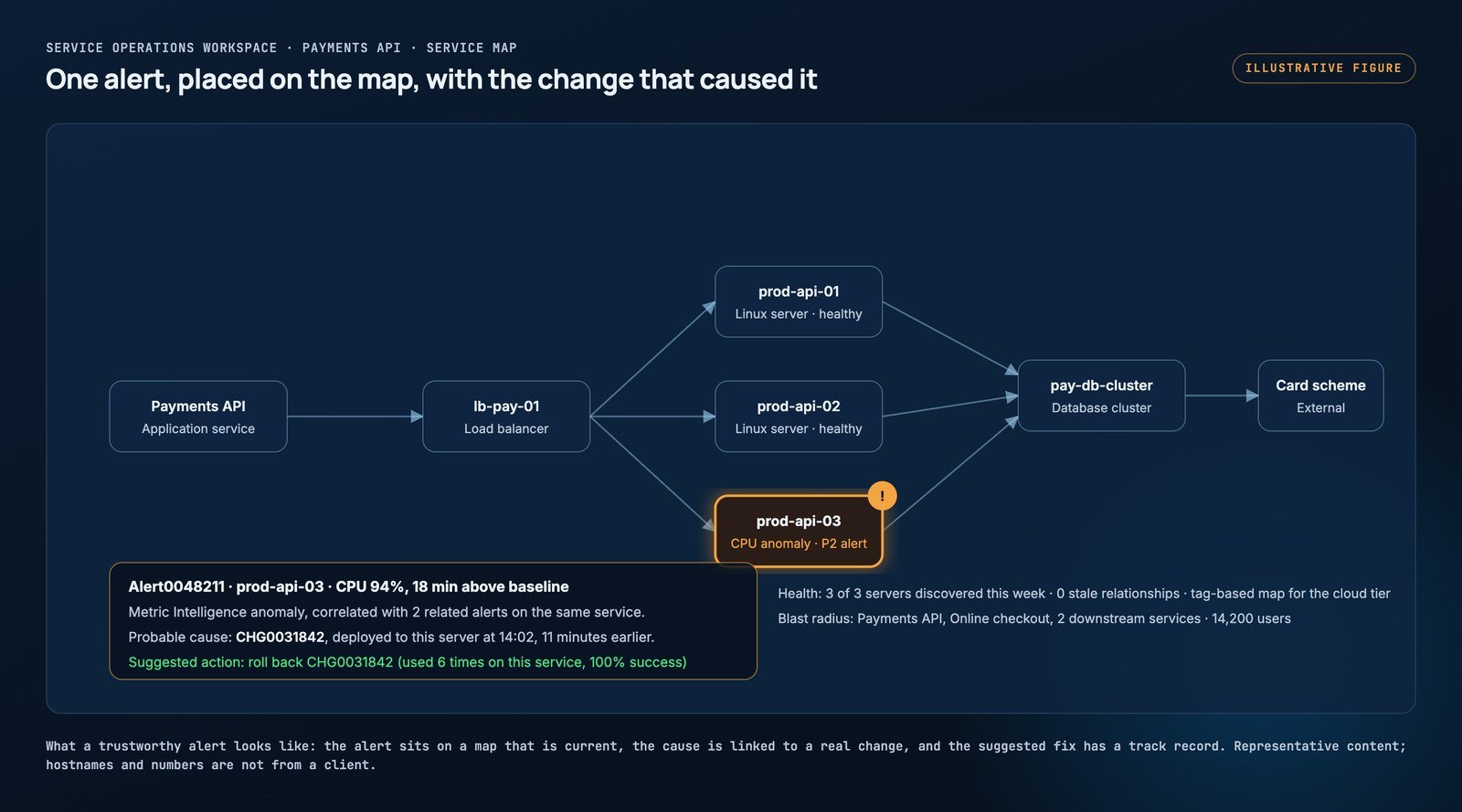
Correlation without service context tells you that three servers are unhappy. Correlation with Service Mapping tells you that the payments service is at risk and who to call. Everything that follows depends on this, so we start every AIOps engagement by mapping the services that matter and connecting the monitoring tools to the CIs those maps contain.
Discovery and Service Graph Connectors do most of the work. Tag-based mapping covers cloud workloads where a traditional top-down map would be out of date by Friday.
When the map is current, an alert stops being a line in a list and becomes a position in a service, with the change that caused it and the blast radius alongside.
2. Let Metric Intelligence and Health Log Analytics find what thresholds miss
Static thresholds produce the two outcomes nobody wants: noise during normal peaks and silence during slow degradation. Metric Intelligence learns the normal band for each metric and raises anomalies when behaviour drifts. Health Log Analytics does the same for log patterns, often an hour before the metric moves. Both run on data you already collect.
The change is in the operating model, not the tooling. Anomaly alerts need an owner and a response, or they become noise of a different kind. We agree that ownership in the same workshop that agrees the service maps.
3. Prove the fix manually before you automate it
For each recurring alert type, document the fix as a runbook and run it by hand through ServiceNow for a month. Record how often it worked, how long it took and what went wrong. This is the evidence that makes automation a decision instead of a leap.
Most estates end up with ten to fifteen remediations that account for the majority of operator time: restarts, disk clean-ups, cache flushes, scaling events and certificate renewals. None of them are glamorous. All of them are worth automating.
4. Automate with guardrails
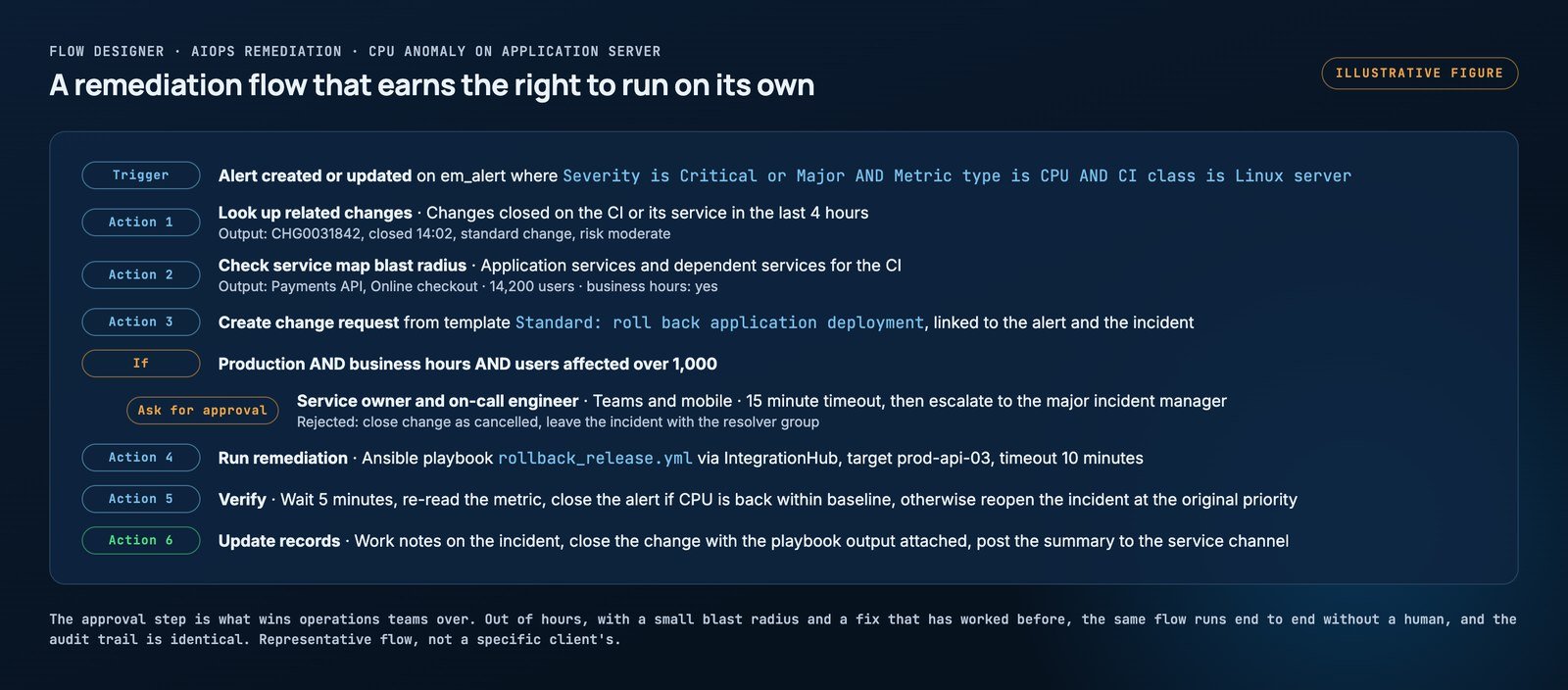
Flows that run the proven fixes, with a change record created automatically, a blast-radius check against the service map, and a human approval for anything in production during business hours. The approval step is what wins over the operations lead. The audit record is what wins over the risk team. Remove the approval only for fixes with a long, clean history.
What good looks like
On programmes we have run for telecom, energy and public-sector operations teams, alert volume typically falls by more than half within the first quarter, and mean time to resolve for the automated categories drops from hours to minutes. More important, the operations team starts using the platform to improve the estate rather than to survive it.
If your Event Management rollout has stalled at correlation, our ITOM and AIOps page describes how we take it the rest of the way.
